
Database management

Latest Stories
-
 Two Years at RENAPS: What a DBA Team Actually Looks Like
At RENAPS, our DBA team operates with deliberate overlap and shared accountability, ensuring no production incident is faced in isolation. Calm, evidence-based decision-making, rigorous peer validation, and institutional knowledge continuity transform individual expertise into collective resilience.
-
 ORMIT™-DB: FROM INVENTORY TO GO-LIVE — ORACLE DATABASE MODERNIZATION, DONE RIGHT
After hundreds of Oracle Database modernization projects, one thing is clear: success depends on early visibility, licensing clarity, and repeatable execution. ORMIT™-DB delivers an automated, industrialized approach—from inventory and analysis to license-aware architecture and controlled cutovers—resulting in audit-ready Oracle 19c multitenant go-lives with a clear path to Oracle 23ai.
-
 Oracle Database Appliance (ODA) Patching Pitfalls to Avoid
Oracle Database Appliance (ODA) patch planning is more complex than typical server updates, touching hardware, firmware, Grid Infrastructure, OS, and database layers. Without disciplined methodology, ad-hoc patching risks downtime, version mismatches, and compliance gaps. RENAPS outlines how structured ODA patching protects stability, security, and lifecycle compliance.
-
 Meet the RENAPS Database & Infrastructure Architects: Modernization, Compliance & Performance
Meet the RENAPS Database Architects who bring deep Oracle expertise in multitenant, GoldenGate, performance optimization, and low-risk modernization. With real-world experience across complex environments, they help organizations reduce risk, streamline migrations, and improve long-term operational reliability. Learn how their approach accelerates success with Oracle databases.
-
 How to leverage AI and Machine Learning in Oracle Database Management?
In today's rapidly evolving technological landscape, artificial intelligence (AI) and machine learning (ML) are at the forefront of transforming various industries. One area experiencing significant change is database management.
-
 Oracle Database Upgrade From 11.2.0.4 To 12.2.0.1 Failed With ORA-06512: At Line 37 ORA-06512
Applies to: Oracle Database - Enterprise Edition - Version 12.2.0.1 and later. Information in this document applies to any platform. Before upgrade, one or more ACL principals are granted with privilege 'resolve' but the ACL has port range defined.
-
 The Power of Oracle 19c Multitenant
In the ever-evolving landscape of database management, Oracle 19c Multitenant architecture emerges as a game-changer. It's more than just an upgrade; it's a strategic shift towards a more efficient, secure, and scalable database infrastructure. For technical experts and organizations, this move to Oracle 19c Multitenant offers a plethora of benefits and advantages that can significantly impact the way databases are managed and utilized.
-
 ODA Schedules: SSH cleaner job to clean up stale SSH keys
Oracle has introduced an additional schedule on the ODA in patch the 19.16 patch bundles. The new schedule, think of it as a job, is called SSH cleaner job to clean up stale SSH keys. Pretty self-explanatory what the schedule does by the name. The new SSH cleaner job schedule is enabled by default and executes every 30 minutes
-
 Oracle Cloud Accelerates Expansion
Oracle expects to open an average of one region every 23 days over the next 15 months for a total of 20 additional regions (17 commercial and three government). As planned, 11 of the countries or jurisdictions served by local cloud regions will have two or more regions to facilitate in-country or in-jurisdiction disaster recovery capabilities. Oracle’s Gen 2 Cloud Infrastructure makes this possible through highly-optimized region deployment technologies, which can implement an entire software defined data center and customer-facing cloud services in days.
-
 How to Win at the Oracle Licensing Game : Introducing ROCS
Unless you are an expert, it’s very easy to be misled by technology license agreements. Licensing complexity, subtle licensing rule changes or price increases, lack of clarity can all lead to non-compliance.
-
 Bug 20936731: ALTER SYSTEM ENABLE/DISABLE RESTRICTED SESSION Breaks Notifications (ORA-1033)
The fix for 20936731 is first included in
• 12.2.0.1 (Base Release)
• 12.1.0.2.170117 (Jan 2017) Database Patch Set Update (DB PSU)
• 12.1.0.2.170117 (Jan 2017) Database Proactive Bundle Patch
• 12.1.0.2.160531 (May 2016) Bundle Patch for Windows Platforms
-
 Bug 16053545 - RMAN cloning from active database fails when overlapped with database backup job
The fix for 16053545 is first included in
• 12.2.0.1 (Base Release)
• 12.1.0.2 (Server Patch Set)
Essential Modernization Insights
-
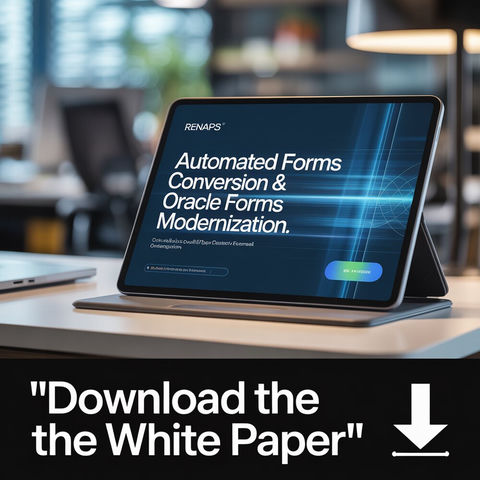
Oracle Forms Modernization White Paper
Modernize your Oracle Forms with confidence: RENAPS’ 49-page white paper shows how ORMIT™-OpenJava migrates them to React or Angular with the form logic in TypeScript, keeps every business rule executable, and makes the application ready for AI agents.
-
Case study: Oracle Forms automated migration to React/Javascript (2024)
A leading insurance company, headquartered in Europe, contacted RENAPS in 2024 seeking a modern, automated migration solution to transition from their legacy Oracle Forms and Reports to a scalable, JavaScript-based architecture with a React frontend. Their objective was to modernize their systems to improve operational efficiency, integrate seamlessly with modern platforms, and meet evolving security and scalability requirements.
-

Break free from Legacy: A guide for Oracle Forms and Oracle Database users
Migrating Oracle applications to open-source technologies can lower costs and broaden talent pools, but requires disciplined planning, compatibility mapping, and quality gates. This article outlines approaches, trade-offs, and best practices to ensure functional parity, maintain performance, and manage risk when transitioning from proprietary Oracle stacks to open-source alternatives.
-

Forms to React/Angular Automated Migration
If you're considering migrating from Oracle Forms to a modern Java/JavaScript architecture, ORMIT™-OpenJava is the ultimate automated solution. It significantly reduces the risks, time, and costs traditionally associated with migrations by leveraging advanced automation and a phased implementation strategy. What sets ORMIT™-OpenJava apart is its ability to retain the familiar trigger-based programming approach of Oracle Forms, ensuring a seamless and intuitive transition for your development team while modernizing your application for today's technological demands.