
RENAPS Blog
Oracle Modernization Insights
Essential Modernization Insights
-
Oracle Forms Modernization White Paper
Modernize your Oracle Forms with confidence: RENAPS’ 49-page white paper shows how ORMIT™-OpenJava migrates them to React or Angular with the form logic in TypeScript, keeps every business rule executable, and makes the application ready for AI agents.
-
Case study: Oracle Forms automated migration to React/Javascript (2024)
A leading insurance company, headquartered in Europe, contacted RENAPS in 2024 seeking a modern, automated migration solution to transition from their legacy Oracle Forms and Reports to a scalable, JavaScript-based architecture with a React frontend. Their objective was to modernize their systems to improve operational efficiency, integrate seamlessly with modern platforms, and meet evolving security and scalability requirements.
-

Break free from Legacy: A guide for Oracle Forms and Oracle Database users
Migrating Oracle applications to open-source technologies can lower costs and broaden talent pools, but requires disciplined planning, compatibility mapping, and quality gates. This article outlines approaches, trade-offs, and best practices to ensure functional parity, maintain performance, and manage risk when transitioning from proprietary Oracle stacks to open-source alternatives.
-

Forms to React/Angular Automated Migration
If you're considering migrating from Oracle Forms to a modern Java/JavaScript architecture, ORMIT™-OpenJava is the ultimate automated solution. It significantly reduces the risks, time, and costs traditionally associated with migrations by leveraging advanced automation and a phased implementation strategy. What sets ORMIT™-OpenJava apart is its ability to retain the familiar trigger-based programming approach of Oracle Forms, ensuring a seamless and intuitive transition for your development team while modernizing your application for today's technological demands.
Oracle Modernization Insights
-
 Oracle Forms Migration Timeline: Can AI Deliver in Two Weeks?
A two-week AI demo migrated one Oracle Forms screen. Here's what actually determines an enterprise migration timeline — and the five deliverables to demand before you accept one.
For CIOs and IT directors, the useful question is how quickly their application can reach that standard.
A recent Vaadin experiment provides a concrete starting point for that discussion.
-
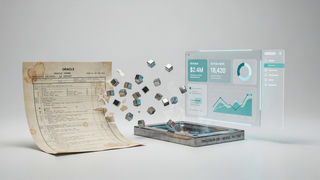 AI Will Not Migrate Your Oracle Forms Application. It Will Rewrite It.
There is a version of the Oracle Forms modernization pitch that sounds very compelling in 2026.
It goes something like this: "AI can now read your PL/SQL, understand your triggers, and generate the equivalent React or Angular application, in seconds per form."
It is not false. But it answers the wrong question.
Oracle Forms modernization is not primarily a code-generation problem. It is a behavioral-preservation problem. And those two problems require completely different solutions.
-
 AI Will Not Rescue Your Oracle Forms Migration: What Oracle's New AI Agent Blog Post Doesn't Say
Oracle's new AI agent blog promises to accelerate Oracle Forms migrations to APEX. It's a compelling pitch - and an incomplete one. AI generates plausible code. Deterministic engines generate correct code. For enterprise systems running mission-critical processes, that distinction is everything. Here's what the blog post doesn't say, and what 300+ migrations taught us instead.
-
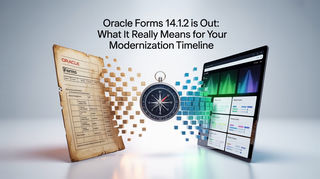 Oracle Forms 14.1.2 Is Out: What It Really Means for Your Modernization Timeline?
Oracle Forms 14.1.2 is not just another upgrade. It is a decision point that will shape your architecture for the next decade.
This article breaks down what the release actually changes, what it doesn’t, and how to decide between upgrading and truly modernizing your Forms estate.
-
 Oracle Forms Modernization: Why Deterministic Conversion Matters More Than AI
Enterprises modernizing Oracle Forms face growing risk from AI-driven inference. Learn why deterministic conversion ensures auditability, functional equivalence, maintainability, and long-term architectural control.
-
 Two Years at RENAPS: What a DBA Team Actually Looks Like
At RENAPS, our DBA team operates with deliberate overlap and shared accountability, ensuring no production incident is faced in isolation. Calm, evidence-based decision-making, rigorous peer validation, and institutional knowledge continuity transform individual expertise into collective resilience.
-
 Upgrade, Extend, or Migrate: The Oracle Forms Decision Most Enterprises Get Wrong
Oracle Forms modernization is rarely a binary or urgent decision. The real challenge lies in choosing the wrong path without understanding application complexity, business pressure, and long-term architectural consequences. This article examines when upgrading, extending, or migrating Oracle Forms makes sense, and how fact-based decisions can turn long-standing legacy systems into sustainable competitive advantages.
-
 ORMIT™-DB: FROM INVENTORY TO GO-LIVE — ORACLE DATABASE MODERNIZATION, DONE RIGHT
After hundreds of Oracle Database modernization projects, one thing is clear: success depends on early visibility, licensing clarity, and repeatable execution. ORMIT™-DB delivers an automated, industrialized approach—from inventory and analysis to license-aware architecture and controlled cutovers—resulting in audit-ready Oracle 19c multitenant go-lives with a clear path to Oracle 23ai.
-
 Oracle Forms Replacement: Why Modernizing Your Legacy System Is the Smarter Path Forward
Many organizations running Oracle Forms face rising risk, talent shortages, and high costs. Instead of replacing it outright, modernizing with ORMIT™-OpenJava preserves business logic, automates conversion to modern React/Node.js stacks, and future-proofs mission-critical applications with lower risk, faster delivery, and long-term maintainability.
-
 Oracle Database Appliance (ODA) Patching Pitfalls to Avoid
Oracle Database Appliance (ODA) patch planning is more complex than typical server updates, touching hardware, firmware, Grid Infrastructure, OS, and database layers. Without disciplined methodology, ad-hoc patching risks downtime, version mismatches, and compliance gaps. RENAPS outlines how structured ODA patching protects stability, security, and lifecycle compliance.
-
 Oracle Forms to Open-Source Migration: 10 Key Success Factors Learned from Real Enterprise Programs
Successful Oracle Forms modernization requires a balance of technical strategy, automation, testing discipline, and team alignment. Beyond selecting a migration tool, organizations must address dependencies, performance baselines, quality gates, and rollback plans. RENAPS highlights critical success factors that reduce risk, accelerate delivery, and ensure long-term operational stability.
-
 Meet the RENAPS Database & Infrastructure Architects: Modernization, Compliance & Performance
Meet the RENAPS Database Architects who bring deep Oracle expertise in multitenant, GoldenGate, performance optimization, and low-risk modernization. With real-world experience across complex environments, they help organizations reduce risk, streamline migrations, and improve long-term operational reliability. Learn how their approach accelerates success with Oracle databases.