ORMIT™-OpenJava · AI agents

Oracle Forms to AI Agents Migrate the rules, not the screens.

ORMIT™-OpenJava migrates your Oracle Forms to React or Angular and keeps every business rule executable. Your employees work on the new screens, and any AI agent operates the same application, under the same rules, through an open connector.

Download the white paper See how it works

  • 96 Oracle Forms trigger types
  • 284 built-ins
  • Every save validated twice
The triggers of an Oracle Forms module, migrated by ORMIT™-OpenJava, run in OFCS, which serves both an employee on a React or Angular screen and an AI agent through an MCP connector. Journal entry · Oracle Forms WHEN-VALIDATE-ITEM PRE-INSERT KEY-COMMIT WHEN-VALIDATE-RECORD ORMIT™-OpenJava OFCS the form’s rules, as TypeScript same rules for everyone Employee React or Angular screen ✓ validated AI agent MCP connector ✓ validated

2026: the year the market repriced software

AI Agents are moving the work off the screen.

Enterprise software is sold per seat, and an AI agent that executes a workflow needs no seat. In early 2026, investors priced that in. Then the market drew the line: software without AI agents gets repriced, software that embeds them keeps its value.

−25%

for the S&P Software & Services index, January 12 to February 23, 2026

$285B
of market value erased in a single session after the AI agent plugins shipped
+41%
for the same index from its April 13 low to October 12, 2026, back at its highs for the year

Sources: The Batch (DeepLearning.AI), February 27, 2026; CNBC, September 3, 2026; 24/7 Wall St., October 13, 2026.

40%

of enterprise applications will embed task-specific AI agents by the end of 2026

Up from less than 5% in 2025.

2025: less than 5%End of 2026: 40%

Source: Gartner, August 26, 2025.

>40%

of agentic AI projects will be cancelled by the end of 2027

  • Escalating costs
  • Unclear business value
  • Inadequate risk controls

Oracle Forms owners already have that control: the rules in their forms.

Source: Gartner, June 25, 2025.

OFCS by the numbers

Oracle Forms Compatibility Service runtime keeps your rules executable

OFCS, at the heart of ORMIT™-OpenJava, reproduces Oracle Forms behaviour where the form expects it, and it is delivered with its source code.

  • 96

    Oracle Forms trigger types

    Reproduced by OFCS, fired at the point where Forms fires them.

  • 284

    Oracle Forms built-ins

    Available to the migrated code.

  • 277

    Oracle Forms properties

    Supported by OFCS.

  • 2×

    Validations of every save

    In the browser, then on the server before the database.

Proven by tests

End-to-end tests are written from the original PL/SQL, and kept only if they fail on a deliberately broken copy of the form.

  • 3,906automated OFCS tests
  • 2,369Java backend tests
  • 303end-to-end scenarios, run on React and Angular

Browser ✓→Node.js validation server ✓→Oracle DB

  • A deterministic conversionThe conversion is built on the form’s abstract syntax tree, not generated by a model. AI works around it: testing, and controlled repairs reviewed by people.
  • Delivered with source codeOFCS ships with its source code, under a licence that does not expire.
  • Your Oracle database staysPackage logic, constraints and grants remain in Oracle. Every write runs under its caller’s own Oracle identity.

Migrate the rules, not the screens

AI agents and employees go through the same rules.

OFCS runs a migrated form’s rules as TypeScript: in the browser as the user works, and on a Node.js validation server with no screen. To the form, an AI agent is one more caller without a screen.

An employee on the web screen and an AI agent through the MCP connector both go through OFCS, which runs the form’s triggers, validations and procedures before the Oracle database. A valid save passes; an entry the form forbids is refused and the form’s message goes back to the AI agent. Employee Web screen React or Angular AI agent MCP connector identity, action log supervises and approves OFCS The form’s rules Triggers Validations Procedures The same for everyone ✓ Valid ✗ Refused Oracle DB Constraints, packages ✓ Saved The form’s message, back to the AI agent Posting date is outside the open period. An employee on the web screen and an AI agent through the MCP connector both go through OFCS, which runs the form’s triggers, validations and procedures before the Oracle database. A valid save passes; an entry the form forbids is refused and the form’s message goes back to the AI agent. Employee AI agent supervises and approves Web screen React or Angular MCP connector own identity, log OFCS The form’s rules Triggers Validations Procedures The same for everyone ✓ Valid ✗ Refused Oracle DB Constraints, packages ✓ Saved ↑ The form’s message, back to the AI agent Posting date is outside the open period.
  1. An employee saves a valid entry from the web screen.
  2. OFCS runs the form’s rules, and the database receives the save.
  3. An AI agent tries an entry the form forbids, through the connector.
  4. The form refuses. The AI agent receives the form’s own message and stops.
A refusal from the form stops the AI agent as it would stop an employee.
  • No path of its own

    The AI agent reaches the database only through the connector and the form’s rules, never around them.

  • An identity of its own

    Its own database account, with only the grants its process needs. Never an employee’s credentials.

  • Every save validated twice

    In the browser as the user works, then on the validation server before the database. Going around the screen does not go around the rules.

Same migration, two more products

The application you migrate is the one AI agents operate.

The migration delivers screens for your employees. The same application, with the same rules, is what an AI agent operates through an open connector. No second migration.

Step 1, migrate: Oracle Forms is migrated by ORMIT™-OpenJava to a React or Angular application with OFCS, which your employees operate on screen. Step 2, operate with AI agents: any AI agent operates the same application and rules through a connector with an open standard, its own identity and a log of every action, while your employees supervise and approve. STEP 1: MIGRATE the migration, and screens for your employees Oracle Forms screens + twenty years of rules ORMIT™-OpenJava migrates the screens and the rules React or Angular application with OFCS: the forms’ rules, executable, before the database Your employees operate on screen STEP 2: OPERATE WITH AI AGENTS an AI agent operates this application, under the same rules the same application,the same rules Any AI agent yours, a platform vendor’s or RENAPS’s the AI agent does the work Connector open standard, the AI agent’s own identity, a log of every action the application becomes operable Your employees supervise and approve Step 1, migrate: Oracle Forms is migrated by ORMIT™-OpenJava to a React or Angular application with OFCS, which your employees operate on screen. Step 2, operate with AI agents: any AI agent operates the same application and rules through a connector with an open standard, its own identity and a log of every action, while your employees supervise and approve. STEP 1: MIGRATE the migration, and screens for your employees Oracle Forms screens + twenty years of rules ORMIT™-OpenJava migrates the screens and the rules React or Angular application with OFCS: the forms’ rules, executable, before the database Your employees operate on screen STEP 2: OPERATE WITH AI AGENTS an AI agent operates this application, under the same rules ↑ the same application, the same rules Connector open standard, the AI agent’s own identity, a log of every action the application becomes operable Any AI agent yours, a vendor’s or RENAPS’s the AI agent works Your employees supervise and approve

1The application becomes operable

An open connector (MCP), or the same operations as a command line or a plain API, with the AI agent’s own identity and a log of every action.

2The AI agent does the work

Process by process, an AI agent proposes and your employees supervise and approve, on the application you already have.

The offer

An application any AI agent can operate.

A migration to AI agents does not replace a screen with a chat window. It changes what you buy, in two tiers, on one source of rules.

  • 1Tier 1

    AI agent-ready

    Delivered with the migration, or added to it. An open connector exposes the migrated form to an AI agent: its blocks, items, lists of values and buttons, in the form’s own order. Every call goes through OFCS and the form’s rules.

    Whose AI agent
    Any: your own, a platform vendor’s, Oracle’s or RENAPS’s.
    Identity
    The AI agent’s own, with only the database grants its process needs. Every action is recorded with the rule it went through.
    How it is proven
    Tested like the rest of the migration: the refusal test, the identity, the record. No model has to be right.
    • MCP
    • Command line
    • Plain API
    • Own identity
    • Action log
  • 2Tier 2

    Operated processes

    One process at a time, an AI agent takes over the work under supervision: it proposes, an employee approves, the rules apply. You choose the AI agent and the model, and you set the pace.

    Whose AI agent
    RENAPS’s, or the one chosen in tier 1.
    Who decides
    Your employees approve before anything counts.
    How it is measured
    Precision on ambiguous cases, cost and time per execution, and the share of cases that no longer need a person.
    • Observation first
    • Human approval
    • Measured cost

Three ways to run a process

Moving a case changes who acts, never what is allowed.

A program, an AI agent or a person on a screen: all three go through the same OFCS rules.

  • A program

    For which cases

    Paths that require no judgement: the lines a rule can match on its own, the postings whose every field is known.

    Who approves

    Nobody, as today. The rules apply.

  • An AI agent

    For which cases

    Ambiguous cases: a payment that almost matches, a claim with a missing document, a request that needs a decision within the rules.

    Who approves

    An employee, who sees what the AI agent proposes and why.

  • A person on a screen

    For which cases

    Where a screen still serves: high-volume keyboard entry, and the exceptions the AI agent cannot settle.

    Who approves

    As today.

OFCSThe same rules under all three

The rules say what the form refuses. They do not say which match is right when several are valid: that is the AI agent’s column, and why approval is not optional.

A worked example

Bank statement reconciliation, with an AI agent in the loop.

A form found in most finance departments. The migrated application keeps its rules: which lines may be matched automatically, which accounts a posting may touch, what makes a reconciliation complete.

  1. The rulesmatch the lines they recognize, as they already do.
  2. The AI agentproposes a match for the remaining lines, with its reasoning.
  3. The employeeapproves or corrects each proposal.
  4. The postinggoes through the form’s commit triggers, so an entry the form would have refused is refused again.

The employee’s day moves from typing every line to settling the exceptions.

Bank statement · reconciliationIllustrative
  • Card settlement2,480.00Matched by a rule✓ Posted
  • Supplier payment, wire12,300.00Matched by a rule✓ Posted
  • Cheque 104821,150.00AI agent: invoice INV-2291same amount and payeeApproved✓ Posted
  • Transfer, partial payment7,940.00AI agent: 2 open itemsthe total matchesCorrected by the employee✓ Posted
  • Bank fee35.00Matched by a rule✓ Posted
  • Deposit, no reference3,000.00AI agent: customer receiptclosest open itemApproved✗ Refused by the form: closed period
Rules: 3 lines · AI agent proposals: 3 linesPosted: 5 · Refused by the form: 1

Safe by construction

The controls come from how the migration is built.

They are not added to the AI agent afterwards.

  • Identity and accountability

    Its own database account, only the grants its process needs, never an employee’s credentials. The AI agent prepares, an employee approves: the separation of duties auditors expect. Every action is logged with the rule it went through, the AI agent that proposed it and the person who approved it.

  • Progressive trust

    The organization decides the pace, process by process.

    1. 1Observation: proposals compared with your employees’ work
    2. 2Each action approved
    3. 3Only exceptions approved
  • Your data, your region, your model

    Through Amazon Bedrock or Google Cloud Vertex AI, prompts and results stay in your cloud account and region. Nothing is sent to a consumer AI service, and the model can be replaced, including by an open model on your own infrastructure.

  • A measured cost

    Each AI agent action has a cost. RENAPS quotes it only once measured on a real form, per execution, and you decide whether you pay for the AI on your own cloud account or through the subscription.

  • The refusal test

    When the AI agent tries something the form forbids, the answer is the same as for a person: the form refuses, the AI agent receives the form’s message, reports it, and does not work around it.

The context layer Gartner asks for

A migrated form already holds it.

Gartner’s AI context platform, trend 4 of its strategic trends for 2027, has three components. The rules are the one no platform vendor can write for you: they exist only in your forms.

  • Gartner componentWhat it holdsIn a migrated application
  • SemanticsOntology, metrics, rules, ownership, policies

    The rules: every trigger, validation and procedure of the form, as TypeScript that OFCS executes. Not a description of the rules. The rules.

  • Operational stateEntities, environment conditions, right-time data

    The form’s blocks, items and lists of values, and the live records in your Oracle database, read through the queries the form itself runs.

  • ProvenanceTracking of data, processes, decisions, actions, outcomes

    The AI agent-ready tier’s action log: for each action, the rule it went through, what the AI agent proposed and the person who approved it.

Gartner’s guidance is to “separate passive business rules from active, machine-generated decision traces.” The rules are code that does not change when the AI agent runs; the AI agent’s reasoning is a trace kept beside them, and it never becomes a rule. OFCS feeds a context platform; it does not replace one.

Source: Gartner, October 20, 2026, Top 10 Strategic Technology Trends for 2027.

The first step

Start with one process. End with numbers.

The first step is the migration itself, then the connector, then one process. It reuses what every RENAPS migration already produces.

  1. Migrate with ORMIT™-OpenJava

    to React or Angular, as the migration project already plans. This is the step that keeps the rules executable.

  2. Make the application AI agent-ready

    The connector, the AI agent’s own identity and the action log. Tested, not measured: the refusal test, the identity, the record, with any AI agent and any model.

  3. Choose one process

    with volume and clear rules: a reconciliation, a claims intake, a permit review.

  4. Write its use cases

    in the use-case workbook RENAPS asks for before every proof of concept. It becomes the AI agent’s task list.

  5. Run it in observation

    The AI agent runs the cases on the migrated forms, observed first. The end-to-end tests written from the original PL/SQL grade every run.

  6. Measure

    the share of cases the AI agent settles, the share it raises, the cost and time per execution, and the time your people get back.

  7. Decide

    which column each case belongs to: the program, the AI agent or a person on a screen. Then move to the next process.

Questions

What clients ask first.

Does the AI agent replace my employees?

No. It takes the cases your rules can settle and proposes the others. Your employees move from data entry to supervision and exceptions. The share of work that moves to the AI agent is measured process by process; it is never promised in advance.

What stops the AI agent from making a costly mistake?

The same rules that stop your employees: the triggers, validations and procedures of your forms, migrated as executable code by OFCS and enforced before the database. The AI agent has no separate path to the database, and it acts under its own identity, with only the rights of its process, never an employee’s. A refusal from the form stops it, and it reports the form’s message. No capability depends on the model being right: the model proposes, the rules decide, and a person approves.

Who is accountable for an entry the AI agent prepared?

The person who approved it, as today. The AI agent prepares, the employee approves: the separation of duties your auditors expect stays in place, and every action is logged with the rule it went through, the AI agent that proposed it under its own identity, and the approver.

Where does our data go?

To your cloud account and region. Through Amazon Bedrock or Google Cloud Vertex AI, prompts and results stay in your account and region. Nothing goes through a consumer AI service, and nothing depends on one model: your migrated rules are your code, the connector uses an open protocol, and the model can be replaced, including by an open model run on your own infrastructure.

Can we use our own AI agent, or a platform vendor’s?

Yes. That is the first tier of the offer: the connector exposes the migrated application to any AI agent, under the same rules, with an identity of the AI agent’s own and a log of every action. The RENAPS AI agent is an option, not a condition.

We are not ready for AI agents yet. Should we still migrate now?

Yes. Oracle Forms follows its own support calendar: Oracle’s published dates give Forms 12c Premier Support until December 2026, and Forms 14.1.2 until 2030. The migration to React or Angular is the first step, and it is the step that keeps the rules executable. The AI agent is added afterwards, process by process, without a second migration.

We already migrated with ORMIT™-OpenJava. What changes for us?

Your application already runs on OFCS, with the same rules. The first step is choosing a process.

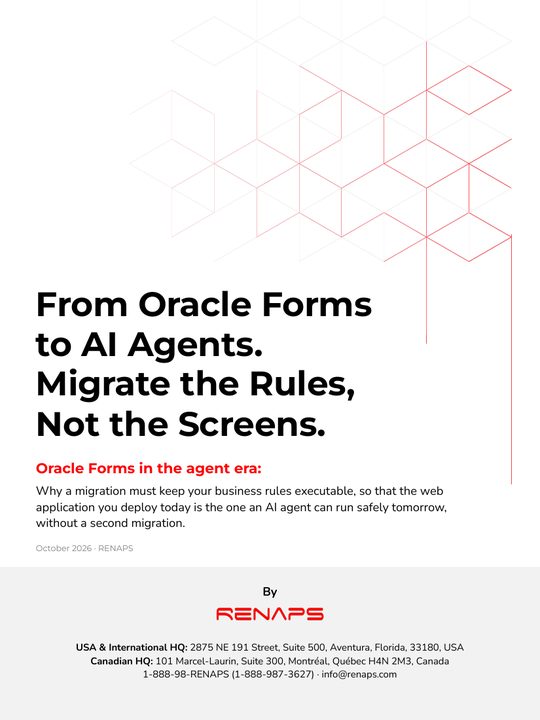
Cover of the RENAPS white paper From Oracle Forms to AI Agents

White paper · October 2026

From Oracle Forms to AI Agents. Migrate the rules, not the screens.

Twenty-five pages on the 2026 market shift, the rewrite trap, how OFCS keeps the rules executable, the two-tier offer, safe-by-construction controls and the first step, with a source for every figure and quotation.

  • Why 2026 ended the idea that a modern web application is the final destination
  • Why the rules in your forms are the control most agentic AI projects lack
  • How any AI agent operates a migrated application safely
  • A first step small enough to decide this quarter

Request the white paper

From Oracle Forms to AI Agents, PDF, 25 pages.

We use these details to follow up on your request. Privacy policy

Prefer to talk it through? Book a working session with our experts: bring one process and its forms.

Calculate your ROI