
Oracle Forms migration: beware the business logic that isn’t in your code
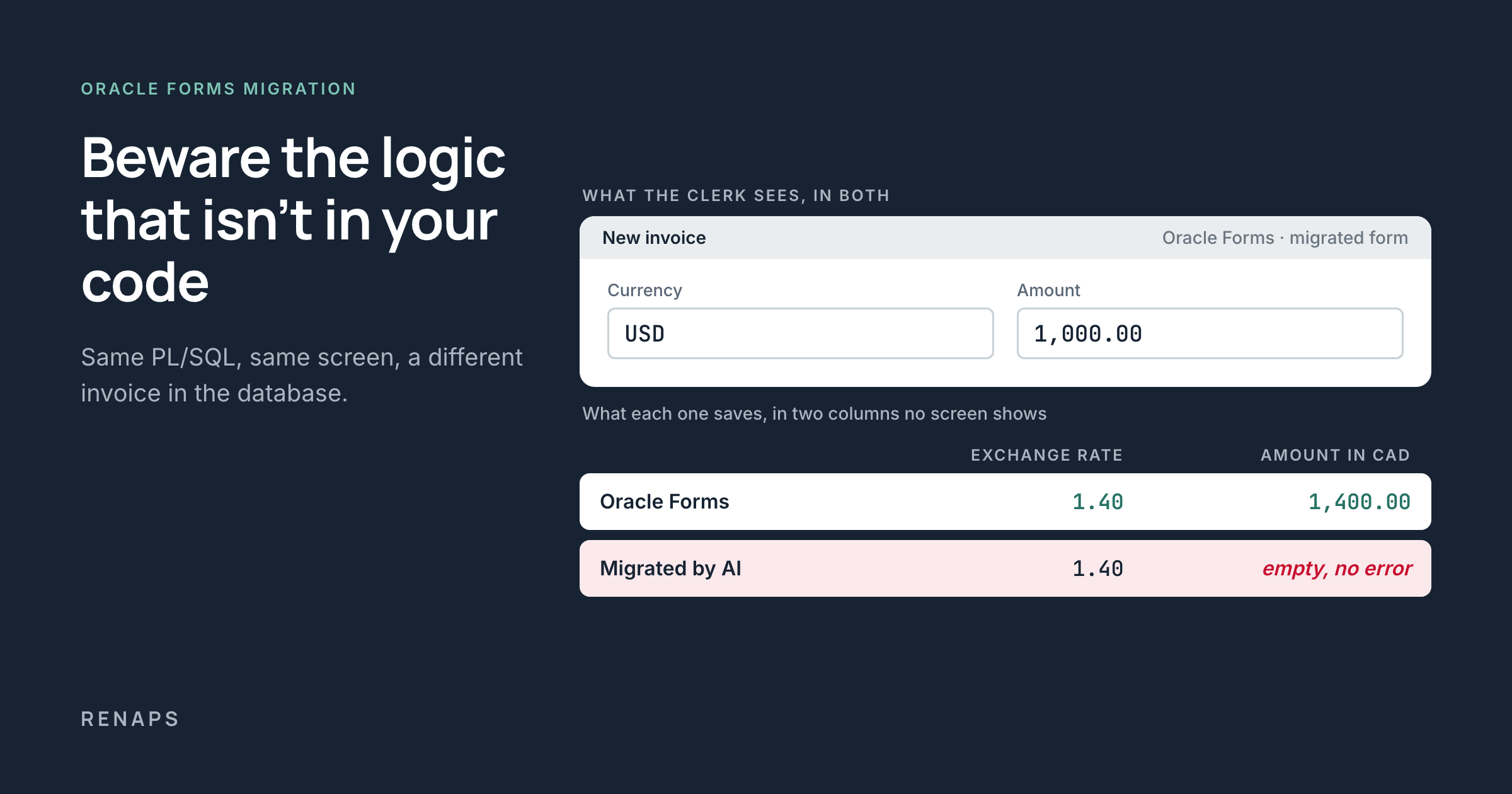
Your Oracle Forms application follows business rules that nobody wrote. They are not in your PL/SQL. Oracle Forms applies them itself, each time it decides which trigger runs, and when. A migration that converts your code line for line leaves them behind, and nothing fails: the screens look right, and the data is wrong.
I have spent more than two years at RENAPS rebuilding those rules. To show one, I wrote an invoice form with three short triggers and gave it to an AI model, six times. Six times it misread the same rule, and three of the forms it wrote save invoices with an amount missing. Here is the rule, why it is hard to fix, and what to check before anyone migrates your forms.
The Oracle Forms migration risk: business rules live in two places
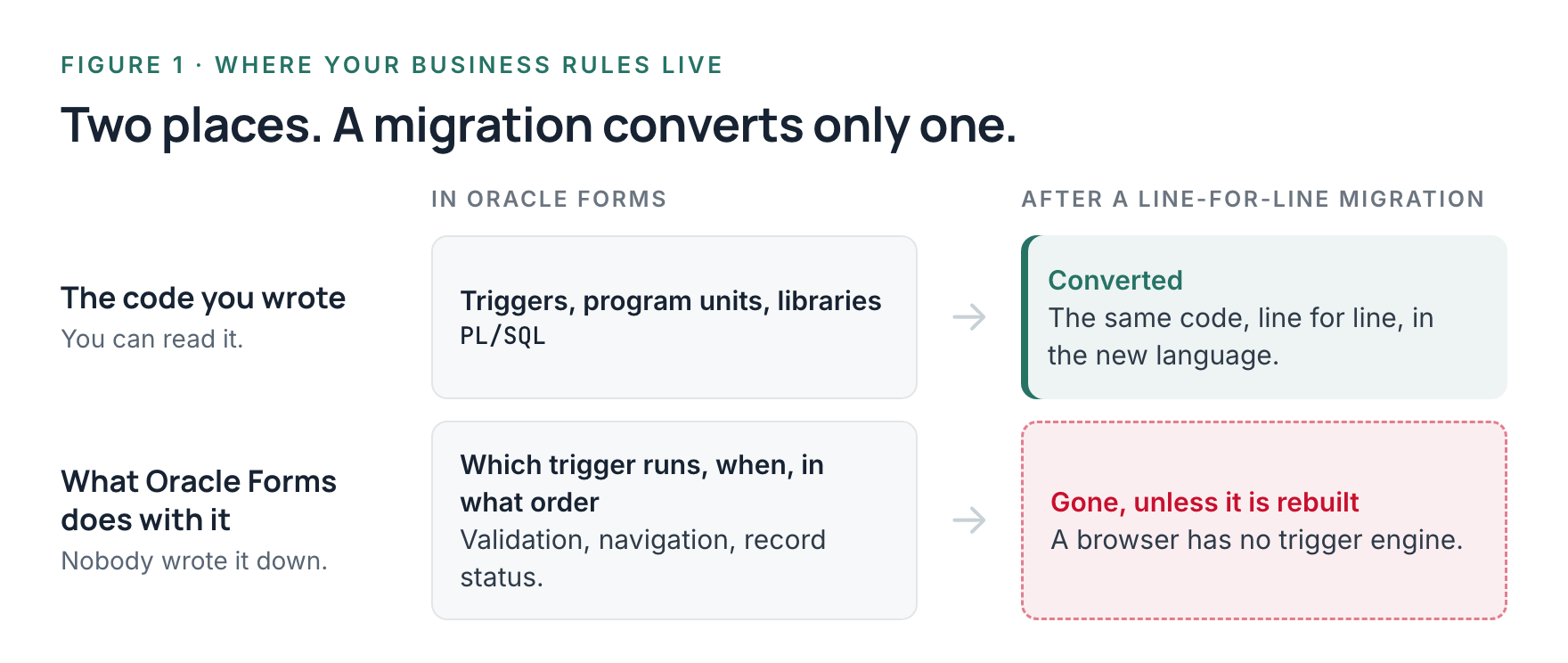
The first place is the code you can read: triggers, program units, libraries. The second is Oracle Forms itself, which decides when that code runs. It validates a field when the user leaves it, when a trigger moves the cursor away, and before a save. It runs item, record, block and form triggers in a fixed order, and each one sees what the previous one left.
Your developers relied on that order every day, usually without thinking about it: a value looked up because the cursor left a field, a total set in one trigger and read in the next. None of that is in their code. Oracle Forms did it for them.
A migration converts the first place. The second has no equivalent in a web application: a browser fires focus, blur and change events in its own order, and has no notion of a record, a block or a trigger. So whoever migrates your forms also has to supply what Oracle Forms did, and first has to know what that was.
Oracle Forms triggers at work: an invoice form
Here is one of those rules, in a form small enough to read whole. The clerk sees two fields: the currency, which defaults to USD, and the amount. Two more columns are saved with every invoice and appear on no screen: the exchange rate, and the amount in Canadian dollars. Three triggers fill them.
The clerk opens the form, types 1000, presses Tab and saves, without touching the currency. Figure 2 follows the three triggers.
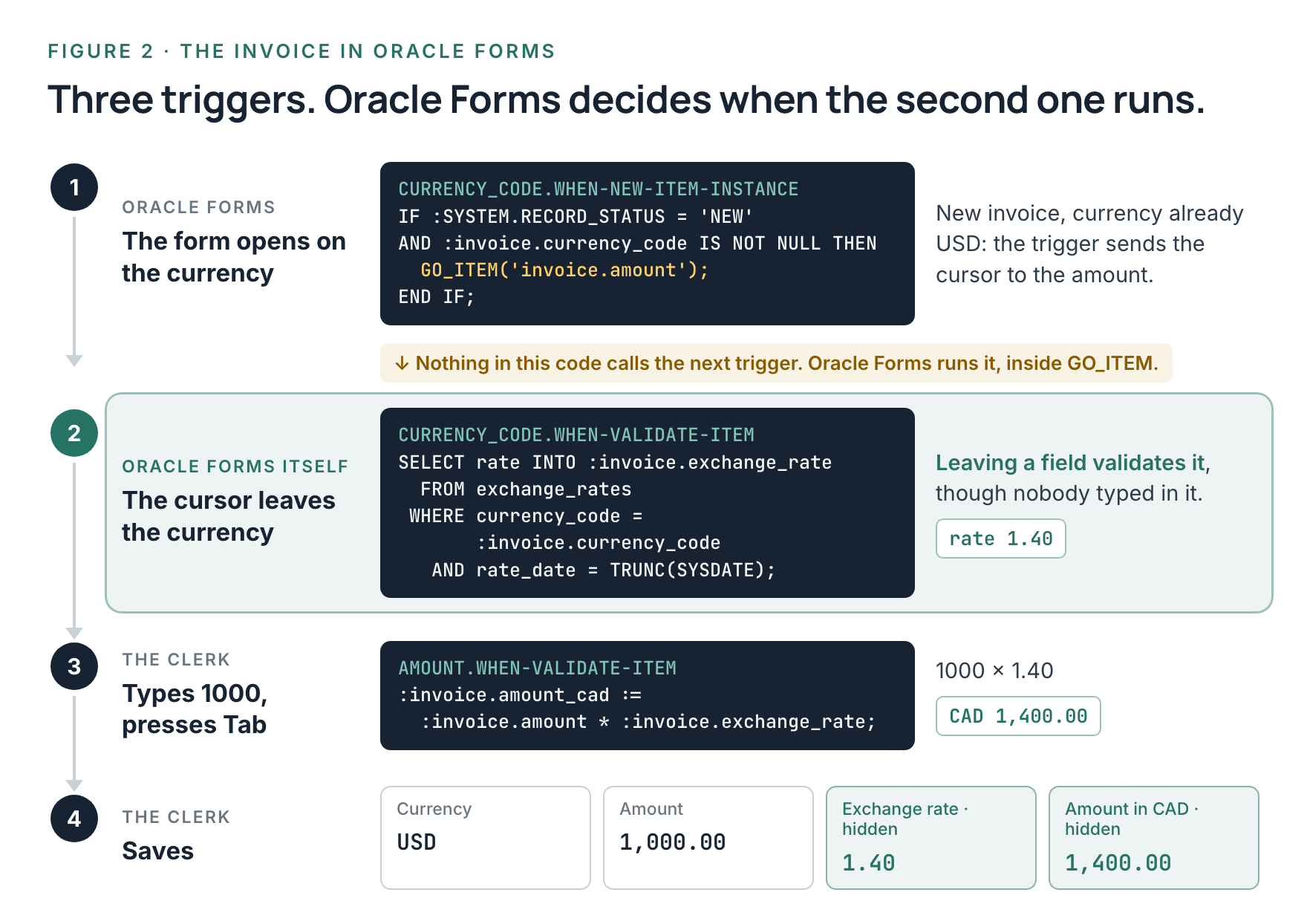
Look at step 2. Nothing in the first trigger calls the currency’s validation. GO_ITEM moves the cursor, and Oracle Forms validates the field the cursor leaves, though nobody typed in it: for Oracle Forms, a new value has to be validated, not only a changed one. That is where the exchange rate comes from. Take that step away, and the rate is still empty when the clerk’s amount is validated. The invoice is saved without its amount in Canadian dollars, with no error, and the clerk’s screen looks the same.
AI migration: we gave the invoice form to an AI model
We use AI every day on this work, and we have argued that AI rewrites an Oracle Forms application instead of migrating it. I gave Claude Opus 5.5, at high effort, the invoice form, with web search allowed. It never used it. I asked two ways, three runs each. First, to migrate the form to React. Then to migrate it like-for-like: behave exactly as the original does, bugs included, and list suspected bugs separately. Both times, I also asked what the original form saves.
All six runs stated the same rule: Oracle Forms does not validate a field that holds only its default value when the cursor leaves it, only later, at the save. By then the amount has been multiplied by an empty rate: hence a rate of 1.40 and no amount in Canadian dollars. Oracle Forms validates the field as the cursor leaves it, as our run of this very form shows, and Oracle’s own reference agrees: its WHEN-VALIDATE-ITEM entry says the trigger fires “for items with the New or Changed validation status”. What the model did next depended on the instruction.
| Oracle Forms | AI, asked to migrate | AI, asked for like-for-like | |
|---|---|---|---|
| Is the currency validated when the cursor leaves it? | ✓ Yes | ✗ “No” | ✗ “No” |
| What the form saves in the hidden columns | ✓ 1.40 and 1,400 | ✓ 1.40 and 1,400, after rewriting the triggers | ✗ 1.40 and no amount in CAD |
| What it reports about your original form | Nothing: it works | ✗ A bug: existing invoices are probably wrong | ✗ A bug, reproduced on purpose |
Asked to migrate, the model rewrote the triggers to fix a bug that does not exist. Its forms save the right invoice, thanks to a rewrite nobody asked for, and come with a defect report the business has to disprove. Asked for like-for-like, it did what it was told: it reproduced Oracle Forms as it believes Oracle Forms works. All three forms save the invoice without its amount in Canadian dollars, and list that as a bug of the original, kept on purpose.
Claude Opus 5.5 is not the only model that gets this wrong, and not every model does. In our benchmark, seven commercial models answered what this form saves, one run each, web search allowed, with and without Tab before saving. Four got both answers wrong: Claude Opus 5.5, Sonnet 5.5 and Haiku 5.5, and Gemini 3.8 Flash. Claude Fable 5.2 got one of the two. GPT-6.2 Astra and Sol got both right, and so did the open model gpt-oss 20b, run locally without search.
Opus read the code correctly every time. What it got wrong is not in the code, and this time it is written: in one line of Oracle’s reference, which none of the six runs looked up. Much of what Oracle Forms does at run time is not written anywhere.
Finding the bug is the easy part
A good test finds this one. Save an invoice in the default currency, read the row back, and the missing amount shows. But the expected value has to come from Oracle Forms, not from whoever migrated the form. All six runs were sure the original saves no amount in Canadian dollars; a test written from that belief checks the wrong value.
The hard part is what you do next. There are two ways to fix it.
| Patch the form | Rebuild the rule | |
|---|---|---|
| What you change | The invoice’s triggers: call the validation by hand | The runtime: leaving a field validates it, as in Oracle Forms |
| How many times | Once for each form that relies on the rule, as you find them | Once |
| Your code afterwards | Moves away from the PL/SQL, form by form | Stays line for line with the PL/SQL |
| What you need to know | That this form is affected | Exactly what Oracle Forms does |
Patching looks cheaper, the first time. But the rule lives in Oracle Forms, so it applies in every form where a trigger moves the cursor out of a field nobody typed in, and you fix each one when a test or a user finds it. After enough patches, you have not migrated your application. You have rewritten it, one bug at a time.
The other way is to fix the rule where it lives: a runtime that does what Oracle Forms does, so the triggers can stay as they were written. That is the part I have been building.
Automated migration with ORMIT™ Open Java: rebuilding what Oracle Forms does
At RENAPS, ORMIT™ Open Java converts each trigger to TypeScript almost line for line: GO_ITEM('INVOICE.AMOUNT') becomes goItem("INVOICE.AMOUNT"). Under that code runs the Oracle Forms Compatibility Service, OFCS: the built-ins, the trigger engine, item and block properties, the :SYSTEM variables, validation and navigation. It has one job: like-for-like. Get it right, and the invoice keeps its amount without anyone rewriting a trigger. Get it wrong, and every migrated form inherits the error.
Oracle Forms built-ins: what the manual leaves out
My first move was the obvious one: build each built-in and trigger as Oracle’s reference describes it. It was not enough. Oracle documents Forms for the developer who uses it, not for someone who has to reproduce it. The GO_ITEM entry says “GO_ITEM navigates to an indicated item.” It does not say which triggers fire on the way, in what order, or whether the rest of the calling trigger runs before or after them. A Forms developer never needs those answers: Oracle Forms simply behaves.
Oracle comparison tests: asking Oracle Forms itself
So we stopped reading and started measuring. Each test is a small form that asks one question, such as “what happens when WHEN-NEW-ITEM-INSTANCE calls GO_ITEM?” Every trigger in it writes a line when it starts and another when it ends, with the item where the cursor stands. We run the form in Oracle Forms and keep its log. Then the same form, migrated, runs on OFCS. If one log line differs, the test fails, and we fix the engine, never the form. The Oracle log stays in the suite, so a rule measured once cannot quietly break later.
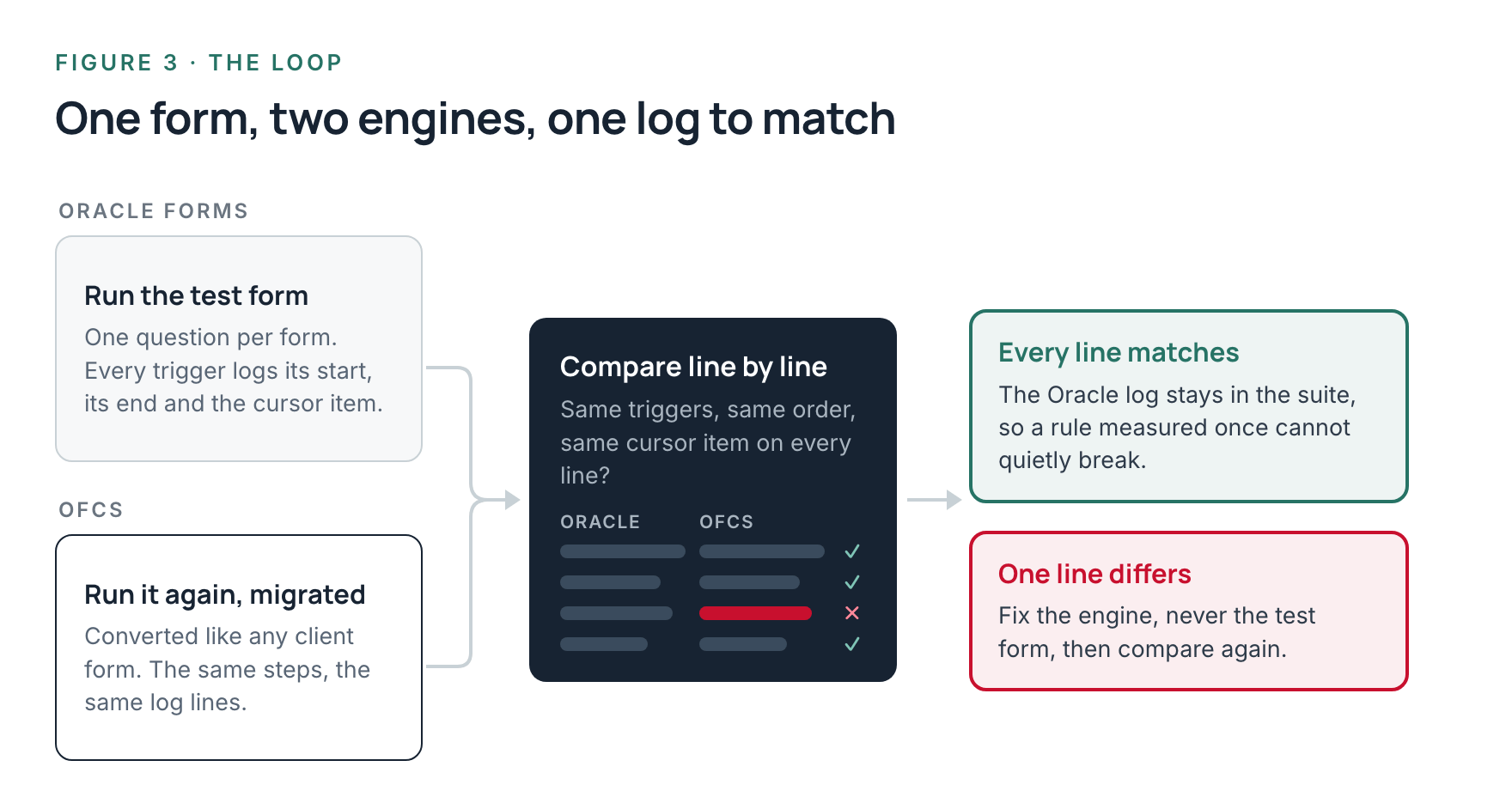
We ran the invoice the same way: Figure 2 comes from that run. Migrated to OFCS, it saves the same two values. OFCS runs migrated forms in production today.
Could your own team build it?
It could, one rule at a time. Ask what happens when a button’s trigger calls GO_BLOCK on the block the cursor is already in. All seven commercial AI models we tested get it wrong, and Oracle’s documentation does not tell you. You would expect nothing to happen. Oracle Forms leaves the block and enters it again: it validates the record and fires the leave and enter triggers.
Now multiply: more than 360 built-ins and 450 properties, and a property can change what a built-in does. A runtime your forms can rely on needs every rule, on every path (navigation, validation, queries, record status, commits), in the right order. Each rule has to be found, checked against a running Oracle Forms, and kept from breaking when the next one is fixed.
It has taken a team of four more than two years so far: over 15,000 person-hours. The hard part was never writing the code. It was knowing what to write, and proving it. The work continues: every new form exercises paths no one has tested yet.
The question is whether you want your team to spend its time there. Every month spent on a second Oracle Forms runtime is a month not spent on what your application is for: the features your users are waiting for, the processes the business wants to change, the screens that deserve a redesign.
After the migration: Oracle Forms’ rules, in code you can read
OFCS comes with every ORMIT™ Open Java migration as part of your source code, under a perpetual licence, with its tests. What Oracle Forms did with your triggers is then written down: each rule as code, checked against Oracle Forms. An AI agent asked why the invoice keeps its exchange rate can read the answer there, where the six runs above guessed. When you redesign a form, your team can see which rules it relied on, decide which to keep, and run the tests to know when they break one.
What I would check before anyone migrates your forms
Find the forms at risk. Convert your modules to XML with frmf2xml, which ships with Forms Builder, and search the triggers that move the cursor themselves: GO_ITEM, GO_BLOCK, GO_RECORD and EXECUTE_QUERY, above all in WHEN-NEW-*-INSTANCE triggers. Then list the items your triggers fill that no screen shows: on no canvas, or not visible. Where the two lists meet, the data depends on rules nobody wrote.
Test whoever will migrate them, a vendor, your own team or an AI. Give them one of those forms, your own, not ours, and ask what Oracle Forms saves on the clerk’s everyday path. Check the answer in a running Oracle Forms, not in the manual. Ask the same of us.
If your triggers rarely move the cursor, or if you are redesigning the application rather than migrating it, these rules matter less.
The invoice is one example. Over more than two years, we have recorded rules like it in Oracle Forms itself, in 45 comparison tests covering navigation, validation, queries, record status and the :SYSTEM variables. Their logs are what OFCS is checked against. Four questions to start with:
Four questions to ask before anyone migrates your Oracle Forms
- When a trigger moves the cursor out of a field nobody typed in, does Oracle Forms validate that field?
- When a rule like this one breaks a form, do you patch the form or fix the runtime?
- Which of our triggers fill columns no screen shows, and how will the migration check them?
- How was each answer checked against a running Oracle Forms?
Ask us those four questions about your own forms. Send us one of your forms for an evaluation: we will tell you what Oracle Forms does with it, and show you how OFCS reproduces it.