 Get Free Assessment
Get Free Assessment
Get Free Assessment
Oracle Forms continues to support critical enterprise applications, but support timelines, talent availability, user experience expectations, and cloud strategy are changing. RENAPS helps you evaluate your options with a factual, source-code-based assessment before committing to a modernization path.
"Most Oracle Forms applications are not failing. In many organizations, they still run core business processes every day. The challenge is not whether Oracle Forms works today. The challenge is whether it remains the right foundation for the next 10 to 15 years of application development, integration, security, hiring, and cloud strategy."
Oracle Forms has served as a reliable enterprise platform for mission-critical applications for decades. The technology is mature and its business logic is often deeply embedded in operations. What has changed is the environment around it: support timelines, developer talent, security expectations, cloud architecture, and user experience standards.
Oracle Forms Premier Support ends December 2029. Extended Support runs through December 2032 at additional cost. Organizations with complex environments need 12 to 18 months to modernize — making 2026 to 2028 the practical planning window.
The Oracle Forms developer community is contracting. Experienced Forms developers are retiring, and few new developers are entering the field. Finding qualified resources for maintenance, enhancements, or a future migration is increasingly difficult and costly.
Enterprise users now expect responsive, mobile-accessible, and modern web interfaces. Oracle Forms was designed for a different era of enterprise computing. Meeting current UX standards requires either significant investment in Forms or a structured migration.
Cloud-first strategies and modern API ecosystems are difficult to integrate with Oracle Forms architectures. Organizations looking to connect ERP, CRM, data platforms, and SaaS tools often encounter significant friction with Forms-based applications.
Security patch availability is tied to Oracle's support lifecycle. As Premier Support ends, the frequency and scope of security updates will diminish. For regulated industries, maintaining compliance on an aging platform introduces increasing risk.
Organizations reviewing Oracle licensing costs as part of broader cloud or infrastructure strategies often include Oracle Forms in that evaluation. Modernization can create architectural flexibility that is difficult to achieve while remaining on the Forms platform.
Migrating to React, Angular, Java, or Node.js opens access to a global pool of mainstream web developers. This reduces hiring risk, lowers long-term maintenance costs, and makes onboarding new team members substantially more straightforward.
Oracle is encouraging customers to consider modernization paths, including APEX. For some organizations, APEX may be appropriate. For others, especially those seeking architectural independence, React or Angular with a modern backend may be a better long-term path.
Oracle Forms modernization is rarely a small project. Large environments may include hundreds of Forms modules, shared libraries, menus, custom PL/SQL logic, integrations, and reporting dependencies. Waiting too long can compress the timeline, increase reliance on scarce expertise, and reduce architectural choices.
Support dates and terms are subject to change. Always verify current Oracle Forms support dates against Oracle's latest official Lifetime Support Policy document before finalizing your modernization timeline.
Oracle APEX can be a practical modernization option for organizations that are committed to the Oracle ecosystem and want to build web applications closely tied to Oracle Database. However, organizations seeking broader architectural flexibility may prefer a modernization path based on React, Angular, Java, Node.js, REST APIs, and cloud-neutral deployment. The right answer depends on your organization's priorities, infrastructure strategy, and long-term roadmap.
| Consideration | Oracle APEX Path | Open Modernization Path (ORMIT™-OpenJava) |
|---|---|---|
| Architecture & Infrastructure | ||
| Database dependency | Requires Oracle Database — APEX runs inside Oracle DB | Database-agnostic — Oracle, PostgreSQL, SQL Server, or other |
| Hosting options | Oracle Cloud Infrastructure or on-prem Oracle stack | Any cloud (AWS, Azure, GCP) or on-premises |
| API & integration | Oracle-native APIs; REST support available | Full REST, GraphQL, microservices — open standards |
| People & Skills | ||
| Developer talent pool | APEX-specific expertise — specialized community | React, Angular, Java, Node.js — global mainstream pool |
| Hiring difficulty | APEX developers are a smaller, specialist group | Broad access to web and backend developers worldwide |
| Ownership & Control | ||
| Source code ownership | Application code owned; runtime requires Oracle DB | Full source code ownership — no ORMIT™ runtime dependency |
| Roadmap control | Architecture constrained by Oracle APEX roadmap | Your team controls architecture, stack, and roadmap |
| Best Fit | ||
| Ideal when | Organization is committed to Oracle ecosystem long-term and Oracle DB dependency is acceptable | Organization seeks cloud-neutral architecture, broader talent access, or reduced Oracle runtime dependency |
Before choosing APEX, React, Angular, Java, Node.js, or another modernization path, organizations need a factual view of their current Oracle Forms environment. ORMIT™-Analyzer reviews the actual source code and metadata to identify complexity, dependencies, triggers, program units, built-ins, menus, libraries, and migration effort. The assessment produces an objective foundation for decision-making — before any commitment is made.
For the analysis phase, RENAPS only requires Oracle Forms and Reports source files (FMB, MMB, PLL, OLB, RDF) and database metadata via Data Pump metadata-only export. No production data is required at any stage. Work is performed in RENAPS' secured environment. If data sharing is not possible, VPN access to a customer non-production environment can be arranged.
A modernization specialist reaches out within one business day to discuss your environment and objectives.
A mutual NDA is signed. Source files are transferred securely to RENAPS' analysis environment. No production data required.
ORMIT™-Analyzer processes your Oracle Forms source code and produces the full assessment report.
RENAPS presents the findings — complexity, effort, risks, and path options — in a structured review session with your team.
You receive a modernization roadmap and path recommendation. No commitment to proceed is required.
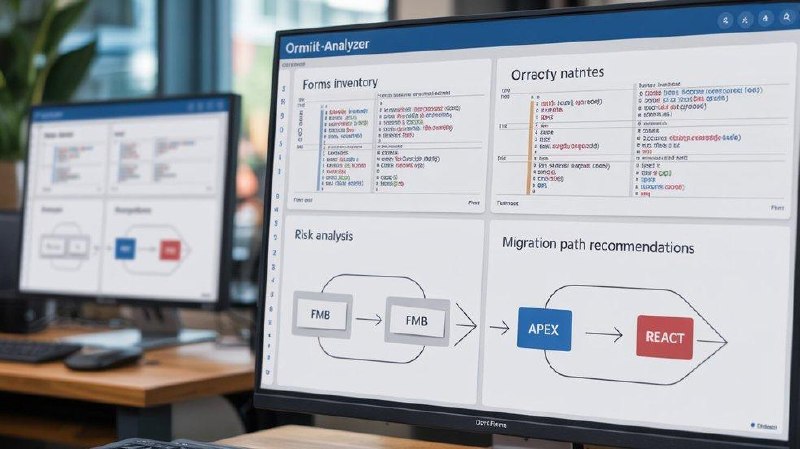
ORMIT™-Analyzer — Forms inventory, dependency mapping, risk analysis, and migration path recommendations
Share a few details about your Oracle Forms environment. A RENAPS modernization specialist will contact you to discuss your application landscape, modernization goals, and whether ORMIT™-Analyzer is a good fit.
No production data required. No obligation.
A specialist typically responds within one business day.
RENAPS has supported Oracle modernization initiatives since 2001, with deep experience across Oracle Forms, Oracle Reports, Oracle Database, and enterprise application modernization. RENAPS combines Oracle expertise with modern application architecture knowledge, allowing customers to modernize without losing the business logic that makes their existing systems valuable.
ORMIT™ is not a general-purpose migration tool adapted for Oracle. It was designed from the ground up for Oracle Forms, Oracle Reports, Oracle Database, and the Oracle application stack. The automation reflects 20+ years of real-world migration patterns.
ORMIT™-Analyzer reviews your actual Forms source code — not assumptions, not industry averages. Every complexity estimate, effort projection, and path recommendation is grounded in what is actually in your environment.
Every RENAPS engagement follows an ISO 9001:2015 certified delivery process. Documented methodology, quality checkpoints, and structured project governance. Modernization projects succeed when they are managed as enterprise programs, not improvised.
Every migration produces a complete application that your organization owns outright. No ORMIT™ runtime dependency. No ongoing licensing to RENAPS. Deploy anywhere, modify freely, maintain with any developer familiar with the target technology stack.
RENAPS supports modernization to React, Angular, Java, Node.js, JasperReports, PostgreSQL, and hybrid strategies. The path is chosen based on your environment and objectives — not a single predetermined destination.
RENAPS employs Oracle ACE Professionals — Oracle's recognized designation for independent technical expertise. This depth of Oracle knowledge is directly applied to understanding the nuance of each migration environment.
Large Oracle Forms environments are rarely migrated in a single effort. RENAPS supports phased migration strategies — by application, by business unit, or by complexity tier — allowing organizations to manage risk and investment over time.
Oracle Reports environments are typically closely tied to Oracle Forms applications. RENAPS has deep experience migrating Oracle Reports to JasperReports and other modern reporting frameworks, and can assess and migrate both in a single engagement.
Oracle Forms is not currently end of life. It is under Premier Support through December 2029, with Extended Support available through December 2032 at additional cost per Oracle's Lifetime Support Policy. After Extended Support ends, only Sustaining Support is available — which provides access to existing patches only, with no new security fixes or defect corrections.
Organizations should verify current support dates and terms directly against Oracle's most recent Lifetime Support Policy documentation, as terms are subject to revision.
After Extended Support ends, Oracle Forms moves to Sustaining Support. Under Sustaining Support, Oracle provides access to previously released patches only. No new patches are issued, no new security vulnerabilities are addressed, and no new defects are corrected. Organizations remaining on Sustaining Support assume responsibility for risks associated with unpatched security issues.
For regulated industries subject to security and compliance requirements, this transition warrants careful planning well in advance of the Extended Support end date.
APEX can be a practical path for organizations that are committed to the Oracle ecosystem and find it acceptable to remain dependent on Oracle Database as their application runtime. APEX offers fast development within the Oracle environment and is a supported Oracle product with its own active roadmap.
For organizations seeking cloud-neutral architecture, broader developer talent access, or reduced long-term Oracle runtime dependency, an open modernization path using React, Angular, Java, or Node.js may be a better fit. The right answer depends on your organization's infrastructure strategy and long-term priorities — which is precisely what an ORMIT™-Analyzer assessment is designed to help you evaluate.
Yes. ORMIT™-OpenJava is RENAPS' modernization framework that automates the migration of Oracle Forms applications to React or Angular frontends with Java or Node.js backends. The resulting application runs on any infrastructure, connects to any database, and is fully owned by the customer with no ongoing RENAPS licensing dependency.
The feasibility, effort, and recommended approach for any specific environment is determined through the ORMIT™-Analyzer assessment, which reviews the actual source code of your Oracle Forms applications.
No. RENAPS does not require access to production data at any stage. For the assessment phase, only Oracle Forms and Reports source files (FMB, MMB, PLL, OLB, RDF) and database metadata via Data Pump metadata-only export are required. For the migration phase, work is performed using non-production or anonymized test data.
Analysis is conducted in RENAPS' secured environment. If source file transfer is not possible, VPN access to a customer non-production environment can be arranged.
ORMIT™-Analyzer processes your Oracle Forms source files and produces a detailed report covering: full module inventory (Forms, Menus, Libraries, Object Libraries), trigger and program unit analysis, Oracle built-in usage, custom code and dependency mapping, complexity scoring by module, DML analysis, migration effort estimates, and risk identification. The output is a factual basis for choosing a modernization path and scoping a migration program.
Timelines vary significantly based on the number of modules, complexity of business logic, integration requirements, and chosen migration path. Most enterprise Oracle Forms environments take 12 to 18 months for a full migration. Organizations with very large or highly complex environments may require longer phased programs.
ORMIT™-Analyzer produces an effort estimate specific to your environment — which is considerably more reliable than industry averages applied without analysis of your actual source code.
Yes, and for most large organizations, a phased approach is recommended. Phasing can be structured by application domain, business unit, complexity level, or dependency cluster. RENAPS supports phased migration planning as part of the modernization roadmap delivered following the ORMIT™-Analyzer assessment.
Yes. Preserving the business logic embedded in Oracle Forms trigger code and program units is a primary objective of ORMIT™-OpenJava migrations. The framework is designed to translate Oracle Forms PL/SQL business logic into equivalent backend code in Java or Node.js, maintaining the operational integrity of the application while modernizing its architecture and user interface.
Yes. Oracle Reports environments are typically closely tied to Oracle Forms applications, and RENAPS has deep experience migrating Oracle Reports to JasperReports and other modern reporting frameworks. An ORMIT™-Analyzer assessment can be scoped to include Oracle Reports alongside Oracle Forms, and a migration program can address both in a coordinated manner.
Your Oracle Forms applications contain years of business logic, process knowledge, and operational value. Modernization should not begin with assumptions. It should begin with a factual assessment of your source code, dependencies, risks, and realistic migration options — delivered before any commitment to a path is made.
Get a Free Oracle Forms Modernization Assessment →